
Book · 2017
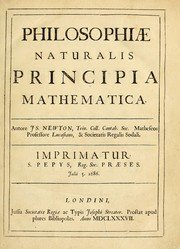
Philosophiae naturalis principia mathematica
- mentions
- 6
- people
- 5
- podcasts
- 5
- episodes
- 6
- recommendations
- 0
Newton's greatest work is called Principia!
 Neil deGrasse Tyson · StarTalk Radio · May 2024 Listen at 27:38
What they say about it
- Referenced in historical discussions“Principia Mathematica was published in 1687”3
The best things said about it
Principia Mathematica was published in 1687.
Leibniz reverse engineered the principia and cooked it backwards so that he could get the results he wanted.
Sir Isaac Newton in his Principia Mathematica, and John Locke, in his Essay Concerning Human Understanding.
And Isaac Newton first demonstrated this-- - [Charles] In Principia.
Neil deGrasse Tyson StarTalk Radio · Aug 2019 Where and when it comes up
Most mentions, by podcast
5 people who brought it up
Why people recommend it
Philosophiae Naturalis Principia Mathematica by Sir Isaac Newton is a foundational scientific text published in 1687 that establishes the laws of motion and universal gravitation, fundamentally shaping classical mechanics and modern physics. The treatise was discussed across several podcast episodes in contexts ranging from historical timelines to scientific discovery. On the Dwarkesh Podcast, Dwarkesh Patel referenced Newton's work to compare the timing of major scientific breakthroughs, noting that Darwin's theory arrived two centuries later. On StarTalk Radio, Neil deGrasse Tyson highlighted Principia as Newton's greatest work while recounting a story about Eddington's eclipse observations, and Charles Liu mentioned it as the text where the concept of orbital motion was first demonstrated. On The Jordan B. Peterson Podcast, Roy Sebag and Jordan Peterson reflected on passages from Newton's writings concerning God and matter. Jed Buchwald discussed the philosophy of science with Lex Fridman on the Lex Fridman Podcast, touching upon historical claims of Leibniz reverse-engineering the Principia. Finally, C. Bradley Thompson mentioned Newton's book on The Rubin Report alongside John Locke's writings to illustrate the intellectual and scientific influences that shaped the American founding fathers.
Every mention
Neil deGrasse Tyson Newton's greatest work is called Principia! So they're off the coast of Principe, and they're observing the… 2
“Newton's greatest work is called Principia! So they're off the coast of Principe, and they're observing the eclipse!”
“And Isaac Newton first demonstrated this-- - [Charles] In Principia.”
C. Bradley Thompson And Sir Isaac Newton in his Principia Mathematica, and John Locke, in his Essay Concerning Human Understanding 1
“And Sir Isaac Newton in his Principia Mathematica, and John Locke, in his Essay Concerning Human Understanding”
Dwarkesh Patel Principia Mathematica was published in 1687. So The Origin of Species comes out two centuries after Princip… 1
“Principia Mathematica was published in 1687. So The Origin of Species comes out two centuries after Principia. Conceptually, it seems like Darwin's theory is simpler.”
Jed Buchwald what mellie found out was that leibniz reverse engineered the principia and cooked it backwards so that he… 1
“what mellie found out was that leibniz reverse engineered the principia and cooked it backwards so that he could get the results he wanted”
Roy Sebag There's a curious passage in the 'Optics.' I don't recall it because I read it many years ago, but it menti… 1
“There's a curious passage in the 'Optics.' I don't recall it because I read it many years ago, but it mentions how God initially formed all matter indestructibly, and there's something about gold shortly thereafter.”
Also mentioned in the same episodes
Other mentions (3: passing, ad reads, own books)
“In honor of Sir Isaac Newton, there is a Spanish wine called Principia Mathematica, which is a bright white wine made with Charello. I'm going to find that wine. Yeah. So, so Principia is his greatest work. Uh, it's the mathematical principles of natural philosophy. Uhhuh. Sensibly abbreviated Principia. Principia. Yeah, but it's Principia Mathematica. If you want to give”
“and you Newton's great work right the prinkipia”
“Francis Bacon in his Novum Organum. And Sir Isaac Newton in his Principia Mathematica, and John Locke, in his Essay Concerning Human Understanding,”