
Book · 2009 · Economics
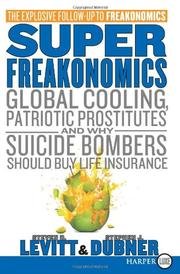
Superfreakonomics
Global Cooling, Patriotic Prostitutes, and Why Suicide Bombers Should Buy Life Insurance
- mentions
- 18
- people
- 5
- podcasts
- 4
- episodes
- 10
- recommendations
- 0
We had just written SuperFreakonomics; Stephen Dubner and I, our second book, and we had worked with a bunch of environmentalists on global warming. We had this chapter where we talked about global warming, and I think it was a thoughtful and honest chapter.
Where and when it comes up
Mentions per year
How it comes up
Most mentions, by podcast
5 people who brought it up
Why people recommend it
Superfreakonomics by Steven D. Levitt and Stephen J. Dubner is the provocative sequel to Freakonomics, using economic principles to analyze unconventional human behaviors, global warming solutions, and altruism. On Freakonomics Radio, Debbie Millman traced the expansion of the franchise through the 2009 publication of this follow-up. In multiple episodes of People I (Mostly) Admire, Steve Levitt reflected on the book's release, noting that it did not achieve the same massive sales figures as its predecessor and recounting how a controversial chapter on climate change led to his first meeting with Daniel Kahneman. Levitt also discussed how environmentalists collaborated on the global warming sections and how private incentives ultimately fail to sufficiently curb carbon emissions. On No Stupid Questions, Stephen Dubner mentioned the book while examining lab experiments purportedly demonstrating altruism, and other segments highlighted Jon Stewart's familiarity with the text.
Every mention
Steve Levitt I was in New York City shortly after the release of super Freakonomics the follow-up to Freakonomics and th… 14
“I was in New York City shortly after the release of super Freakonomics the follow-up to Freakonomics and that book was proving to be quite controversial because of a chapter we had written on climate change”
“Let's take *Super Freakonomics*, the second book that Steven Dubner and I wrote. There was every reason for it to be a huge success. We had just written *Freakonomics*, we knew how to write a book, but honestly, it didn't sell nearly as many copies as *Freakonomics* did.”
“Jasper didn't interview me Jen Stewart read for economics and super Freakonomics and internalized them and had a conversation with me off air that made me think he was one of the smartest people I had ever met”
“And a prediction that I made that I wish hadn't been true but turned out to be quite true was Stephen Dubner in the book Super Freakonomics. We suggested that because of private incentives, the attempts to rein in carbon emissions just weren't going to work, and we predicted that the globe would struggle to control our emissions of greenhouse”
“We had just written SuperFreakonomics; Stephen Dubner and I, our second book, and we had worked with a bunch of environmentalists on global warming. We had this chapter where we talked about global warming, and I think it was a thoughtful and honest chapter.”
“Have you ever gone back and read just chunks of Freakonomics or Super Freakonomics?”
“I discovered first hand just how sensitive the topic of geoengineering is when Stephen Dubner and I wrote about it in our book super Freakonomics”
“I discovered firsthand just how sensitive the topic of geoengineering is when Stephen Dubner and I wrote about it in our book, SuperFreakonomics.”
“so Stephen Dubner and I we wrote about solar geoengineering in our book super Freakonomics back in 2009 and we were strong supporters”
“Stephen Dubner and I wrote about solar geoengineering in our book SuperFreakonomics back in 2009, and we were strong supporters.”
“And yet, when you and I spoke a few years ago, you mentioned that you believed SuperFreakonomics had set back the field of geoengineering by five years and slowed down progress and research.”
“we're not very happy we're not with super Freakonomics to be honest it's like I had looked back at that section of super Freakonomics in five or ten years”
“To be honest, I've looked back at that section of SuperFreakonomics in the past five or ten years, and in preparation for our conversation, I reread it, and I have to admit that what you just criticized was true: it was somewhat starry-eyed and overly optimistic regarding what we could achieve.”
“13 years ago when we wrote super Freakonomics I believe geoengineering deserved much more attention and investment than it was receiving and I continue to believe that today even more strongly”
David Keith not that what it said was wrong and the thing that's helped the big environmental groups inch towards takin… 1
“not that what it said was wrong and the thing that's helped the big environmental groups inch towards taking this seriously and governments in short taking this seriously has been really putting it in context and being very careful not to over claim several of us in the field it wasn't just me we're not very happy we're not with”
 Debbie Millman If that isn't enough, the freconomics universe expanded with the subsequent publication of Super Freconomic… 1
“If that isn't enough, the freconomics universe expanded with the subsequent publication of Super Freconomics in 2009,”
 Stephen Dubner and then we also wrote in super Freakonomics about something that might not strike many people's cheating b… 1
“and then we also wrote in super Freakonomics about something that might not strike many people's cheating but I would argue that it was we wrote about these lab experiments that purported to show altruism”
 Steven Levitt so after our second book super economics came out and we wrote about climate change and what was interestin… 1
“so after our second book super economics came out and we wrote about climate change and what was interesting going back to idea of scientists”
Also mentioned in the same episodes

Other mentions (16: passing, ad reads, own books)
“For what it's worth, we wrote about the dictator game at length in super freconomics and a related game called ultimatum.”
“I'm just reflecting on the most prominent attempt to cancel me which happened after Steven Dubin and I published super freconomics and we had a discussion of geoengineering.”
“but we went back and in our second book super Freakonomics we actually retold the story as well as we could including the incentives for the reporters involved and the police involved”
“athletic Talent is considered one of the more heritable traits passed from parent to child in super Freakonomics one of the books I wrote with the economist Steve levit We performed a rough calculation showing that if a major league baseball player has a son that boy is about 800 times more likely than a random boy to also make”
“and in our second book super Freakonomics we actually retold the story as well as we could including the incentives for the reporters involved and the police involved”
“so let's just take super Freakonomics the second book that Steven duer and I wrote there's every reason why that should have been a huge success we had just written Freakonomics we knew how to write a book but honestly it didn't sell nearly as many copies as Freakonomics”
“Here's how Steve levit and I wrote about this scenario in our book super Freakonomics a story about two men”
“we wrote about this in our book super Freakonomics in a chapter called unbelievable stories about apathy and altruism”
“we wrote about this a little bit in super Freakonomics”
“so by then we had two books for economics and super Freakonomics and we'd started Freakonomics radio”
“I believe it was in Super Freakonomics but we looked at the birth date bulges”
“although drunk walking we actually argued in super Freakonomics is more changes per mile than junk driving”
“I was in New York City shortly after the release of super Freakonomics the follow-up to Freakonomics”
“so I expected to be delused with anger emails because that's what happened when we talked about solar geoengineering back in super Freakonomics”
“in the book super Freakonomics we suggested that because of private incentives the attempts to reign in carbon emissions just weren't going to work”
“Nathan we had just written super Freakonomics Stephen Dubner and I our second book and we had worked with a bunch of environmentalists on global warming”