
Book · 2017 · Business & Economics
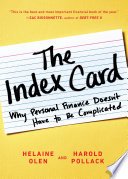
The Index Card
Why Personal Finance Doesn't Have to Be Complicated
- mentions
- 7
- people
- 3
- podcasts
- 2
- episodes
- 4
- recommendation
- 1
It really is as simple as Harold argues in his book the index card in just about any Economist you ask will agree.
 Steve Levitt · People I (Mostly) Admire · Jan 2023 Listen at 43:35
What they say about it
- Co-authored by Helaine Olen“co-authored with the journalist Helaine Olen”5

- Explains personal finance simply“why personal finance doesn't have to be complicated”3
The best things said about it
You published a book called The Index Card: Why Personal Finance Doesn't Have to Be Complicated, and you co-authored that with Helaine Olen, and it was really a big hit like you said. I think it's affected so many people's lives.
Steve Levitt People I (Mostly) Admire · Jan 2023 One popular book in choice analysis is called The Index Card: Why Personal Finance Doesn't Have to Be Complicated. It was written by Helaine Olen, a journalist, and Harold Pollack, who is a professor at the University of Chicago.
Stephen Dubner Freakonomics Radio · Oct 2022 That didn't stop him from turning his index card into a book co-authored with the journalist Helaine Olen. It is called, yes, The Index Card.
Stephen Dubner Freakonomics Radio · Aug 2017 As you may recall, Harold Pollack's index card had nine rules. But his and Helaine Olen's book, called The Index Card, has ten.
Stephen Dubner Freakonomics Radio · Aug 2017 Why people recommend it
The Index Card by Helaine Olen and Harold Pollack is a practical guide explaining that personal finance does not have to be complicated, distilling sensible financial strategies down to basic, manageable rules. Stephen Dubner discussed the book extensively on Freakonomics Radio, noting that it originated from a viral index card created by University of Chicago professor Harold Pollack and journalist Helaine Olen. Dubner examined how the book builds upon Pollack's original nine rules by adding a tenth rule, and he highlighted the text as part of a study on savings advice conducted by James Choi. Harold Pollack himself appeared on the podcast to reflect on why he included specific principles, such as the social-safety-net rule, emphasizing that many people genuinely need financial help. Additionally, Steve Levitt brought up the book on People I (Mostly) Admire, discussing its major success and real-world impact in the outro of an episode. Levitt reiterated that managing money and avoiding high fees truly is as straightforward as Pollack argues in the book, noting that economists broadly agree with its foundational advice. Across these podcast appearances, the speakers emphasized the clarity, accessibility, and widespread positive influence of the authors' straightforward financial philosophy.
Every mention
Steve Levitt it really is as simple as Harold argues in his book the index card in just about any Economist you ask will… 2
“so you published a book called the index card why personal finance doesn't have to be complicated and you co-authored that with Helene Olin and it was really a big hit like you said I think it's affected so many people's lives”
“it really is as simple as Harold argues in his book the index card in just about any Economist you ask will agree”
Stephen Dubner one popular book in Choice analysis is called the index card why personal finance doesn't have to be compli… 4
“one popular book in Choice analysis is called the index card why personal finance doesn't have to be complicated it was written by Helene Olin a journalist and Harold Pollock who is a professor at the University of Chicago”
“That didn't stop him from turning his index card into a book co-authored with the journalist Helene Olin. It is called, yes, The Index Card. Why personal finance doesn't have to be complicated.”
“When my colleagues at the business school saw this and they saw what these rules were, they were just like, you're kidding. But that didn't stop him from turning his index card into a book co-authored with the journalist Helene Olin. It is called, yes, The Index Card.”
“As you may recall, Harold Pollack's index card had nine rules. But his and Helene Olin's book, called The Index Card, has ten. Rule number ten.”
Harold Pollack One is there's a lot of people who need help. Secondly, to the extent that my story is a part of our book,… 1
“One is there's a lot of people who need help. Secondly, to the extent that my story is a part of our book, it would not be fully honest if I left off rule number nine.”
Also mentioned in the same episodes

Other mentions (1: passing, ad reads, own books)
“Oh, I just have to look at these nine rules on this card. Everything you ever wanted to know about personal finance and it fits on one index card.”