

Person
Daron Acemoglu's book recommendations
Key facts
- Daron Acemoglu has recommended or discussed 2 books on podcasts, as of February 3, 2024.
- Daron Acemoglu has talked about books on 1 podcast, as of February 3, 2024.
- Those books came up in 1 episode, as of February 3, 2024.
- The 2 books Daron Acemoglu has mentioned in the most episodes, as of February 3, 2024: Power and Progress and Why Nations Fail.
- The latest episode with a book mention from Daron Acemoglu aired on February 3, 2024.
Updated
Kamer Daron Acemoğlu is a Turkish-American economist of Armenian descent who has been at the Massachusetts Institute of Technology since 1993, where he is currently the Elizabeth and James Killian Professor of Economics. He was named an Institute Professor at MIT in 2019. His primary research fields include political economy, development economics, and labor economics. He received the John Bates Clark Medal in 2005, and the Nobel Memorial Prize in Economic Sciences in 2024. Appearing on People I (Mostly) Admire, Acemoglu discussed several of his co-authored books. He talked about Power and Progress, which he co-authored with Simon Johnson, noting that the book features a central examination of Henry Ford's factories and automation to highlight the choices societies make regarding technology. He also discussed Why Nations Fail, a book co-authored with James A. Robinson, explaining how the project was triggered by questions surrounding the fundamental role of political and economic power in national development.
Books Daron Acemoglu recommended or discussed
-
Power and Progress
Discussed“and that's also what motivated my more recent book power and progress”
Where to get it
-
Why Nations Fail
Discussed“that's what triggered the why Nations fail book which you have so kindly explained in the master way”
Where to get it
Books by Daron Acemoglu
-
Why Nations Fail
-
Power and Progress
-

Economic origins of dictatorship and democracy
-

NBER macroeconomics annual 2006
-

Advances in Economics and Econometrics
-
Economics
-
Productivity differences
-

NBER Macroeconomics Annual 2012
-
Microeconomics, Global Edition
-
The Narrow Corridor
-
Minimum wages and on-the-job training
-
Nber - Macroeconomics Annual
-
Institutions as the fundamental cause of long-run growth
-
Dynamics of information exchange in endogenous social networks
-
Innovation by entrants and incumbents
-

Macroeconomics, Student Value Edition
-

Macroeconomics
-
Microeconomics, Pearson EText, Global Edition
-

Macroeconomics, Global Edition
-
Economics, Global Edition
-
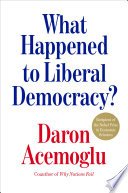
What Happened to Liberal Democracy?
Appearances
| Episode | Podcast | Date | Books |
|---|---|---|---|
| 124. Daron Acemoglu on Economics, Politics, and Power | People I (Mostly) Admire | 2024-02-03 | 3 |
Other mentions (8: passing, ad reads, own books)
“I try to convey this in the book, but perhaps not clearly enough—but what I think brought liberalism’s crisis. In two words, liberalism crisis is related to the rise of a post-industrial economy in which what you just called the educated elite has become both much more powerful and more numerous”
“If I take a step back, and this relates to both Hayek and to some of the themes that I try to develop in What Happened to Liberal Democracy?, I believe that liberalism and the kinds of society that we want to build that supports freedom does need decentralization.”
“that's what triggered the why Nations fail book which you have so kindly explained in a masterful way”
“and that's also what motivated my more recent book power and progress”
“That's what triggered the "Why Nations Fail" book, which you have so kindly explained in such a masterly way, and that's also what motivated my more recent book "Power and Progress."”
“That's what triggered the "Why Nations Fail" book, which you have so kindly explained in such a masterly way, and that's also what motivated my more recent book "Power and Progress."”
“you know why Nations failed the book that I wrote with Jim Robinson for example was really what I would have loved to write as a teenager”
“you know I've always been a big admirer of Schumpeter and his ideas and we make creative destruction an important part of our overall narrative in why nations fail James and I James Robinson and I”