
Book
The Situation Room
- mentions
- 10
- person
- 1
- podcast
- 1
- episode
- 1
- critical mentions
- 0
It gives you a way to understand how these presidents make decisions in crises, which is where you can truly see who the president is, what they stand for, and their values.
What they say about it
- Understanding current politics“helpful way of understanding this election”2
The best things said about it
George Stephanopoulos talks to Dan about covering 2024 in his new book, which is full of untold stories about the White House Situation Room.
I want to pivot to your book because I think it's fascinating, and I think it actually is a very helpful way of understanding this election.
Being able to tell their stories was just a great treat, and frankly, to go back to the top of our discussion, it was a wonderful tonic or antidote to dealing with our current politics every morning.
My insight after spending the last couple of years on this book is that the deep state is packed with patriots who are doing an amazing job.
In some ways, the Trump chapter was the most difficult to write because we've all become so numb.
Why people recommend it
The Situation Room by George Stephanopoulos is a political history and non-fiction book that explores the inner workings of the White House Situation Room and the high-stakes crises managed by American presidents. The book was prominently featured during an episode of Pod Save America, where Dan Pfeiffer and a podcast host welcomed George Stephanopoulos to discuss his forthcoming work. The host highlighted the book as a fascinating inside story that serves as an effective and helpful lens for understanding the current presidential election, as well as a refreshing antidote to the daily anxieties of modern politics. During the interview, Stephanopoulos shared insights gained from writing the book, noting that his research revealed the deep state to be filled with dedicated patriots rather than shadowy bureaucrats. The discussion underscored how the project allowed the author to collect untold stories from professionals who navigated historic emergencies, ultimately offering readers a profound look at leadership under pressure. Podcast hosts continually steered listeners toward the book as both a riveting historical account and a crucial guide for comprehending modern executive power and national security crises.
Every mention
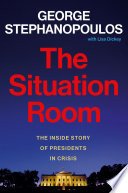
Dan Pfeiffer joining now to discuss his forthcoming book The Situation Room the inside story of presidents in crisis 1
“joining now to discuss his forthcoming book The Situation Room the inside story of presidents in crisis”
Mentioned on the show without a named speaker9
“Later, George Stephanopoulos talks to Dan about covering 2024 in his new book, which is full of untold stories about the White House Situation Room.”
“Joining now to discuss his forthcoming book, The Situation Room, the inside story of presidents and crises, something both of us have some experience with, he's co-host of Good Morning America and anchors This Week on ABC, George Stephanopoulos.”
“I'm gonna get to your fascinating book in a second, but I want to start with this campaign we're in the middle of.”
“I want to pivot to your book because I think it's fascinating, and I think it actually is a very helpful way of understanding this election.”
“Being able to tell their stories was just a great treat, and frankly, to go back to the top of our discussion, it was a wonderful tonic or antidote to dealing with our current politics every morning.”
“And it turns out, we've heard a lot about the deep state in the last several years; my insight after spending the last couple of years on this book is that the deep state is packed with patriots who are doing an amazing job.”
“You picked the Situation Room and talked to the professionals, but this is obviously a way to highlight the crises that these presidents dealt with.”
“It gives you a way to understand how these presidents make decisions in crises, which is where you can truly see who the president is, what they stand for, and their values.”
“Well, in some ways, the Trump chapter was the most difficult to write because we've all become so numb.”
Other mentions (7: passing, ad reads, own books)
“You've got a whole host of other projects; like, why in God's name did you write a book? What made you do this?”
“Each time I had an internal standard for myself, and I don't want to cast aspersions on any of my colleagues in the journalism world, but my one bar for me was that it couldn't be like a potted book.”
“And number two, I really wanted to do a book that felt new and different at least to me, and it would be a book where I would consider it a good book if I read it.”
“I started a book many years ago, and I could tell four chapters in that it was not meeting that standard, so I put it aside.”
“In this case, somebody came to me and said, 'How about a book about the Situation Room?'”
“There was one book by a former staffer, a guy named Michael Bone, which came out 20 years ago, and when I heard that it really hadn't been done and saw that it could be a window into looking at crisis management in the White House, I immediately said, 'Wow, this is a great idea.'”
“I should also add that I'm in the aides' village of writing a book; I certainly wrote it, but I had a co-writer, Lisa Dickey, and I had a terrific research team—Cameron Peters and Emily Michelle—and they were just fantastic.”