
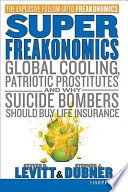
Why people recommend it
SuperFreakonomics by Steven D. Levitt and Stephen J. Dubner is a popular economics book that applies unorthodox statistical analysis to everyday human behavior, altruism, and social phenomena. On Freakonomics Radio, Stephen Dubner discussed a calculation from the book co-authored with economist Steve Levitt, demonstrating through rough estimates that Major League Baseball players' sons are significantly more likely to reach the majors than average boys. In another episode, the host referenced a chapter titled Unbelievable Stories About Apathy and Altruism. On No Stupid Questions, Stephen discussed how the book also explores the economics and social perspectives of the sex industry, specifically prostitution. Additionally, Dubner noted on Freakonomics Radio that the book details historical anecdotes, such as the rise of electric cars in the 1890s. On StarTalk Radio, James Altucher shared an anecdote recalling how Stephen Dubner was initially anxious about how the book would perform prior to its release, only for it to swiftly climb the bestseller lists. The book continues to engage readers with its provocative economic inquiries and surprising data-driven insights.
Who recommended it
- Neil deGrasse Tyson Discussed
Neil deGrasse Tyson — 1 mention
“but you were worried you didn't know how the book would do and you were scared and I said I was lying I was just being nice I said don't worry it's gonna be a big hit Cuz I read the galley but I just was being nice I didn't know and then you called me a few days led”
Mentioned on the show without a named speaker — 4
“In Super Freakonomics, one of the books I wrote with economist Steve Levitt, we performed a rough calculation showing that if a Major League Baseball player has a son, that boy is about 800 times more likely than a random boy to also make the majors.”
“We wrote about this in our book "Super Freakonomics" in a chapter called "Unbelievable Stories About Apathy and Altruism."”
“We wrote about this a little bit in Super Freakonomics; we're writing about prostitution actually as a sort of industry that we studied from economic and social perspectives.”
“You may remember this story from Super Freakonomics, where we told it in some detail, perhaps too much detail.”
Also mentioned in the same episodes
Other mentions (2: passing, ad reads, own books)
“And it turns out that if you pull apart the story of what actually happened that night—which is a little difficult to do, CU this was in the 1960s—but we went back, and in our second book, Super Freakonomics, we actually retold the story as well as we could, including the incentives for the reporters involved and the police involved.”
“Although drunk walking, we actually argued in Super Freakonomics, is more dangerous per mile than drunk driving, but that's a different story. Maybe for the person who's drunk, but maybe not for other people.”