
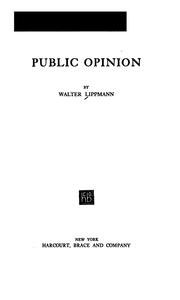
Book · 1997 · Political Science
Public opinion
- mentions
- 5
- people
- 5
- podcasts
- 4
- episodes
- 5
- recommendations
- 2
The second book would be Walter litman's public opinion and I think that was published in 1922.
The best things said about it
You know read walter littman's uh public opinion.
 Josh Barnett The Joe Rogan Experience · Jun 2024
 So you go back to Walter Lipman's book, "Public Opinion," which I think comes out in 1922, if I'm not wrong, right around there. And Walter Lipman's answer to the reality that the world outside our heads differs from the world inside our heads.
 Ezra Klein The Ezra Klein Show · Sep 2026
 In the books propaganda and public opinion this was something that they figured out a hundred years ago specifically during the woodrow wilson administration.
This a wood Wilson idea right wood yeah it's a wi Wilson era thing almost 100 almost exactly 100 years ago is when this started um and in particularly there's there's a book called public opinion written by a guy Nam Walter Litman that sort of Define this at the time what I'm about to describe.
 Marc Andreessen The Ben & Marc Show · Jan 2024
 Where and when it comes up
Most mentions, by podcast
5 people who brought it up
Why people recommend it
Public Opinion by Walter Lippmann is a foundational political science text published in 1922 that examines how media, stereotypes, and psychological biases shape the thoughts and actions of the citizenry in a modern industrial democracy. The book was highlighted by several podcast guests exploring political communication and propaganda. On The Ezra Klein Show, Sean Illing recommended the text, praising Lippmann for accurately diagnosing the deep-seated problems of democratic governance and the gap between reality and perception. Josh Barnett also recommended the book on The Joe Rogan Experience during a discussion on public perception and psychological manipulation. In a separate episode of The Ezra Klein Show, host Ezra Klein brought up Lippmann's core premise regarding how the world outside our heads differs from the pictures inside our heads, using it to analyze modern information ecosystems. Marc Andreessen cited the book on The Ben & Marc Show to trace the historical origins of universities and think tanks acting as expert policy advisors to the government during the Wilson era. Additionally, Michael Malice referenced the text on The Jordan B. Peterson Podcast within a broader historical conversation about statecraft, media management, and the manufacturing of consent.
Every mention
Josh Barnett you know read walter littman's uh public opinion 1
“you know read walter littman's uh public opinion”
Sean Illing the second book would be Walter litman's public opinion and I think that was published in 1922 1
“the second book would be Walter litman's public opinion and I think that was published in 1922”
Ezra Klein So you go back to Walter Lipman's book, "Public Opinion," which I think comes out in 1922, if I'm not wrong… 1
“So you go back to Walter Lipman's book, "Public Opinion," which I think comes out in 1922, if I'm not wrong, right around there. And Walter Lipman's answer to the reality that the world outside our heads differs from the world inside our heads”
Marc Andreessen this a wood Wilson idea right wood yeah it's a wi Wilson era thing almost 100 almost exactly 100 years ago… 1
“this a wood Wilson idea right wood yeah it's a wi Wilson era thing almost 100 almost exactly 100 years ago is when this started um and in particularly there's there's a book called public opinion written by a guy Nam Walter Litman that sort of Define this at the time what I'm about to describe”
Michael Malice in the books propaganda and public opinion this was something that they figured out a hundred years ago spe… 1
“in the books propaganda and public opinion this was something that they figured out a hundred years ago specifically during the woodrow wilson administration”
Also mentioned in the same episodes



Other mentions (1: passing, ad reads, own books)
“and then there's walter littman's book public opinion those are the two”