
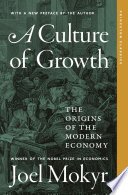
Book · 2026 · Business & Economics
A Culture of Growth
The Origins of the Modern Economy
- mentions
- 7
- people
- 3
- podcasts
- 2
- episodes
- 2
- recommendation
- 1
We should all read your book, and while I understand we have to be careful about how we extrapolate from history, we can certainly learn a lot from it and it really sheds light even on our modern world in new ways.
What they say about it
- Drivers of the Industrial Revolution“drove the Industrial Revolution”2

- Cultural progress and changes2

The best things said about it
The proposition I put forward here is that the explosion of technological progress in the West was made possible by cultural changes.
Stephen Dubner Freakonomics Radio · Mar 2026 In the acknowledgements to your book, A Culture of Growth, you write that much like Rabbi Aka, you learned the most not from your teachers or peers, but from your students.
Stephen Dubner Freakonomics Radio · Mar 2026 His new book, A Culture of Growth: The Origins of the Modern Economy, is about what really drove the Industrial Revolution.
That's basically the central message of my book. It's a weirdly unexplained driver of the Industrial Revolution; people usually fixate on the more obvious things like the printing press etc.
Joel Mokyr a16z Podcast · Nov 2016 You have this newest book talking about the drivers and the cultural that drove the cultural progress of this you know unprecedented Industrial Revolution.
Why people recommend it
A Culture of Growth by Joel Mokyr is a historical examination of the cultural and economic changes that drove technological progress and the Industrial Revolution in the West. Erik Torenberg recommended the book on the a16z Podcast, encouraging listeners to read it because, while cautioning against historical overextrapolation, it offers valuable and novel insights into the modern world. Stephen Dubner also discussed the book on Freakonomics Radio, quoting its central thesis that the unprecedented explosion of western technological progress was fundamentally enabled by cultural shifts. Dubner further referenced the book's acknowledgments to prompt a conversation about the intellectual debts Mokyr owed to his students rather than his peers. During their appearance on the a16z Podcast, the host introduced Mokyr and summarized how the text explores the true drivers of the Industrial Revolution. Mokyr himself elaborated on these themes, highlighting the critical role played by the Republic of Letters, a virtual intellectual network. He explained that this overlooked network served as the central, unexplained driver of historical industrial growth, eclipsing more obvious factors like the printing press. Torenberg and other speakers frequently returned to the book to examine how its historical account of cultural progress can inform contemporary perspectives on technology, demonstrating the enduring relevance of Mokyr's historical analysis for modern readers seeking to understand the deep roots of innovation and societal transformation.
Every mention
Erik Torenberg we should all read your book and while I understand we have to be careful about how we extrapolate from his… 2
“you have this newest book talking about the drivers and the cultural that drove the cultural progress of this you know unprecedented Industrial Revolution”
“we should all read your book and while I understand we have to be careful about how we extrapolate from history we can certainly learn a lot from it and it really sheds light even on our modern world in new ways”
Joel Mokyr and that plays a very important role in this book which is known as the Republic of Letters the rest públic… 2
“and that plays a very important role in this book which is known as the Republic of Letters the rest pública litter area as they call it in Latin and what it is it's it's a virtual network”
“and that's basically the central message of my book it's a weirdly unexplained driver of the Industrial Revolution people usually fixate on the more obvious things like the printing press etc”
Stephen Dubner Let me read a bit from his best known book. It's called A Culture of Growth: The Origins of the Modern Econ… 2
“Let me read a bit from his best known book. It's called A Culture of Growth: The Origins of the Modern Economy. He writes, The proposition I put forward here is that the explosion of technological progress in the West was made possible by cultural changes.”
“In the acknowledgements to your book, A Culture of Growth, you write that much like Rabbi Aka, you learned the most not from your teachers or peers, but from your students.”
Mentioned on the show without a named speaker1
“his new book a culture of growth the origins of the modern economy is about what really drove the Industrial Revolution”
Also mentioned in the same episodes
Other mentions (1: passing, ad reads, own books)
“I mean talk about a culture of growth it's an origin of the modern economy happening right now in a weird way even though it's a very ancient society”