
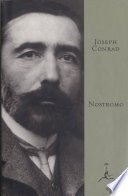
Book · 2000 · Fiction
Nostromo
Nostromo by Joseph Conrad has been mentioned in 2 episodes across 2 podcasts (0 episodes recommend it and 2 episodes discuss it), through . Most frequently brought up by Richard Hanania (1 episode), Robert Evans (1 episode) and Tyler Cowen (1 episode) on Behind the Bastards (1 episode) and Conversations with Tyler (1 episode).
- episodes
- 2
- podcasts
- 2
- people
- 3
- episodes recommend it
- 0
It’s a timeless lesson in that these countries, they need Western capital and Western expertise in order to develop.
Questions about Nostromo by Joseph Conrad
Who has discussed Nostromo by Joseph Conrad on podcasts?
No speaker in our archive has explicitly recommended Nostromo by Joseph Conrad; Richard Hanania (1 episode), Robert Evans (1 episode) and Tyler Cowen (1 episode) have discussed it across 2 podcasts (3 people in all).
Which podcasts mention Nostromo the most?
Behind the Bastards (1 episode) and Conversations with Tyler (1 episode).
Is Nostromo recommended, or only discussed?
Nostromo by Joseph Conrad was recommended in 0 episodes and discussed without a recommendation in 2 episodes, as of 2026-11-04.
What do people say about Nostromo?
Richard Hanania on Conversations with Tyler (2026-11-04): "It’s a timeless lesson in that these countries, they need Western capital and Western expertise in order to develop."
When was Nostromo last mentioned on a podcast?
Nostromo by Joseph Conrad was last discussed on Conversations with Tyler by Tyler Cowen on 2026-11-04.
What they say about it
- Discusses political themes“Latin American dysfunction”3
- Rereads the novel“a book which I reread”2
The best things said about it
Does that mean he thinks classical liberalism is something that you shouldn’t even bother trying to bring to the Third World, or that’s something that is destined to end terribly?
I think he’s more interested in showing us a fundamentally tragic nature of reality.
Tyler Cowen Conversations with Tyler · Nov 2026 Now, why is Nostromo told in such a manner where it does not have a normal synchronization of the narrative? Time shifts radically pretty frequently.
Tyler Cowen Conversations with Tyler · Nov 2026 Fredric Jameson once wrote famously that a Latin author could not have written Nostromo.
Tyler Cowen Conversations with Tyler · Nov 2026 I also found it very important to read this novel twice and twice in a row.
Tyler Cowen Conversations with Tyler · Nov 2026 The beginning of Nostromo, there’s a quotation from Shakespeare.
Tyler Cowen Conversations with Tyler · Nov 2026 Why people recommend it
Nostromo by Joseph Conrad is a sweeping novel of revolution, greed, and political corruption set in the fictional South American republic of Costaguana. Tyler Cowen and Richard Hanania discussed the book on Conversations with Tyler, noting they chose it jointly to open their dialogue. Hanania argued that the text offers timeless lessons on the necessity of Western capital and expertise for developing nations, despite the inherent political unpopularity of foreign intervention. He also challenged Cowen's interpretation of the novel by pointing to the economic progress brought by the Gould silver mine and the surprising loyalty of its workers. Conversely, Cowen and Hanania debated the moral standing of characters like Nostromo, whom Cowen viewed as a vain antihero corrupted by his environment, citing Teresa's sharp criticisms of his character. They explored the psychological toll of ambition and the stark choices facing individuals operating under extreme political pressure. Ultimately, the speakers analyzed how Conrad portrays the tragic inevitability of compromise and the complex interplay between idealistic motives, economic imperatives, and the corrosive nature of power in developing societies.
Every mention
Richard Hanania I think Conrad admires him. He’s an antihero, right? Everyone thinks this thing is sunk. He’s basically sac… 1
“I think of Latin American dysfunction to be caused by socialism ideas that started to take off in the 20th century, in the second half of the 20th century. It is so modern, even though the word socialism doesn’t appear in the book until near the very end.”
“It’s a timeless lesson in that these countries, they need Western capital and Western expertise in order to develop. The problem is there’s nothing politically less popular than just a bunch of rich foreigners coming around and doing a bunch of things.”
“Getting to the end, to the spoilers, the miners actually march on the city because they’re so loyal to Gould. They like what’s going on. There is actual improvement in people’s lives. It’s not that nihilistic, right?”
“Compared to the demagogues, compared to the Montero, these half-literate, various kind of guys who go around torturing people and just trying to grab as much wealth as possible—like Gould, what’s his biggest flaw? He’s not emotionally expressive.”
“Can you run the mine and be better than Gould in the way his wife is? No. It’s a tragic situation, unquestionably. This isn’t Ayn Rand. There’s so many hints of it.”
“I think Conrad admires him. He’s an antihero, right? Everyone thinks this thing is sunk. He’s basically sacrificed himself. He’s vain. I think that’s his problem. He’s vain.”
“No, I don’t think he’s asking us to admire what’s going on with the girls. Yes, you’re right. That’s a good point about contrasting the relationships. I still look at this as basically Nostromo’s vain, stop the presses.”
“I think you’re right. That is Conrad’s view. Does that mean he thinks classical liberalism is something that you shouldn’t even bother trying to bring to the Third World, or that’s something that is destined to end terribly?”
“They’re nasty. They have no ideas. They just want to grab. They’re vain. They’re cowardly too. Sotillo, the way he kills Hirsch, the way he thinks about hiding under his desk at one point.”
“I was thinking about this when I read that essay, “Autocracy and War,” that you recommended. It’s written by Conrad. Basically, it’s about Russia and Japan, and he’s anti-Russian.”
Robert Evans So, it was Joseph Conrad's novel, Nostromo, that that this Atlantic writer and uh Bronze Age Pervet both lo… 1
“So, it was Joseph Conrad's novel, Nostromo, that that this Atlantic writer and uh Bronze Age Pervet both loved. Yeah. Yeah. Here, I'll read you another [ __ ] paragraph. For many years, we corresponded.”
Tyler Cowen We decided jointly we would start off the conversation by discussing Joseph Conrad’s Nostromo, a book which… 1
“We decided jointly we would start off the conversation by discussing Joseph Conrad’s Nostromo, a book which I reread, and he was reading, I think, for the first time.”
“Teresa has the best critique of him. Oh, you just care what people think of you. People are paid to praise you. You’re really a fraud, she basically says. I think Conrad is showing us he’s a victim of the place he moves to.”
“He’s considering the two Viola daughters. They’re called girls, right? We don’t know. They’re called girls and there is some passage of time, but they’re not that old.”
“He would blow everything up from loyalty and from hate, from hate of those liberals, as they call themselves, liberals. The words one knows so well have a nightmarish meaning in this country. Liberty, democracy, patriotism, government, all of them have a flavor of folly and murder.”
“The clamor of this Negro Liberalism”—capital letters Negro Liberalism—“frightened Señor Avellanos. A newspaper was the only remedy. Conrad is mocking. It’s like, oh, we have a newspaper in response, but the classical liberals are just as absurd.”
“I think he’s more interested in showing us a fundamentally tragic nature of reality and comparativism, correctly or not, it’s the last thing he wants to bring into the question. He is like Shakespeare, in fact.”
“Now, why is Nostromo told in such a manner where it does not have a normal synchronization of the narrative? Time shifts radically pretty frequently. It’s one reason why it can be hard to read. Why is it done that way?”
“There’s no God, really, religion, or priests in this story either. In general, in Conrad, there’s not, right? Yes. What do you make of that? For me, it’s the point about tragedy again.”
“Fredric Jameson once wrote famously that a Latin author could not have written Nostromo. Agree or disagree. Maybe, or disagree. I don’t know. Is it just the fact that it’s too unsympathetic to Latin America and not as optimistic about what its domestic politics can produce, perhaps?”
“Then, toward the end of the story, the United States starts taking a role. It’s a bunch of brief mentions, but Conrad seems to understand that’s the future. The English people, the Goulds, well, they’re trapped, and they’re of the past anyway.”
“We both read this. We both prepared. Some of our listeners might read this book, but they’re certainly reading other books. What did you do to read this? How did you read it? What else did you do?”
“I also found it very important to read this novel twice and twice in a row. I’d read it once, something like 30 years ago. That helped me a little, but not actually that much, because I’ve never worked on it since then.”
“The beginning of Nostromo, there’s a quotation from Shakespeare. I quote, Conrad chose this: “So foul a sky clears not without a storm,” which I think is from King John. Lovely part. What’s your current view on Shakespeare?”
“Now, Conrad in Nostromo, and I think elsewhere, he’s pretty critical of the media, and you’ve written in defense of the media. That was a few years ago. Now that you have a few more years of data, we see the media covering AI, covering all sorts of things.”