Why people recommend it
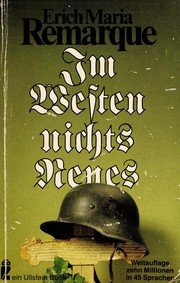
All Quiet on the Western Front by Erich Maria Remarque is a classic anti-war novel that depicts the harsh physical and mental stress of German soldiers during World War I, alongside the detachment from civilian life felt upon returning home. The book was discussed on the Lex Fridman Podcast, where host Lex Fridman spoke with Andrew Huberman. During the conversation, Fridman recalled the novel and highlighted a memorable line comparing the experience of war to the distinct smell of a skunk, noting an almost strange, dark quality in experiencing it. Although other episodes referenced in the broader discourse touched on unrelated texts like the Book of Job with guests such as Dr. Carol Swain, Mary Harrington, Ronnie Janoff-Bulman, and Douglas Murray, Remarque's novel remains a towering literary touchstone for its unvarnished portrayal of industrial warfare. It captures the lost generation with harrowing precision, stripping away romantic notions of patriotism to expose the brutal reality faced by young soldiers in the trenches. The enduring power of Remarque's writing lies in its ability to translate the trauma of frontline combat into a universal warning about the devastating human cost of international conflict.
Who recommended it
Mentioned on the show without a named speaker — 5
“I actually think there's a rule there; look at what happens in The Book of Job. Job is in a situation where he loses virtually everything, plus he becomes extremely ill, to the point where his wife says there's nothing left for you to do but shake your fist at God and die, and Job refuses to lose faith in”
“There's a tremendous emphasis in classic religious tradition; you see this particularly in the Book of Job—that you're to be grateful for your fate, no matter what it is—because being grateful for your fate, no matter what it is, is actually the best way of approaching your fate.”
“Well, it's interesting, because the Book of Job is one of the books that really sets the stage in the biblical corpus for the story of the crucifixion, right? Because the crucifixion story is the story of Job expanded even more thoroughly, right?”
“So, I've been considering the Book of Job in some depth recently, and it's a very interesting book that pertains to purpose. By the time the Book of Job is written and eventually introduced into the biblical corpus, there's a real transformation in the conceptualization of God.”
“Do you remember the book 'All Quiet on the Western Front' from World War I? There's a line that compares war to the smell of a skunk—from there’s an almost delicious quality in experiencing it.”