
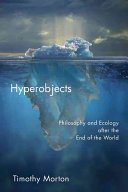
There's this he's actually an english professor named timothy Morton who wrote a book about climate he calls it a hyper object which is like it's a it's a phenomenon that's so big that we can't actually hold it in our heads at once.
 David Wallace-Wells · The Joe Rogan Experience · Mar 2019 Listen at 25:11
What they say about it
- Recommends reading the book“recommend reading Timothy Morton's book”2
- Quotes from the book“Quoting from Morton's book”2
The best things said about it
If you want to learn more about this, I would recommend reading Timothy Morton's book, Hyperobjects. Um it is an academic read, but it's not that bad. I would I would recommend picking it up if you want to learn more about these things.
Quoting from Morton's book, Hyperobjects: The Philosophy and Ecology after the End of the World. Quote, "Consider raindrops. You can feel them on your head, but you can't perceive the actual raindrop in itself.
Again, I'll quote from the book Hyperobjects. Quote, "Late itself is the most viscous thing of all since nothing can surpass its speed.
Where and when it comes up
Mentions per year
How it comes up
Why people recommend it
Hyperobjects by Timothy Morton is a philosophical exploration of massive ecological phenomena, such as climate change and radiation, that are so vast and enduring that humans can only perceive them in fragments rather than in their totality. On Behind the Bastards, Garrison recommended the academic yet accessible book to listeners wanting to understand contemporary ecological concepts. Garrison used quotes from Morton's text to explain how raindrops and radiation demonstrate the elusive and viscous nature of hyperobjects, noting how radiation acts like Jean-Paul Sartre's conceptual jar of honey seeping around human bone structures. On The Joe Rogan Experience, David Wallace-Wells also discussed the book, introducing English professor Timothy Morton's framework for understanding climate phenomena that are simply too large for the human mind to hold all at once. Furthermore, guests on Behind the Bastards referenced the work to contrast its grim ecological framing with alternative perspectives on the end of the world.
Every mention
David Wallace-Wells there's this he's actually an english professor named timothy Morton who wrote a book about climate he call… 1
“there's this he's actually an english professor named timothy Morton who wrote a book about climate he calls it a hyper object which is like it's a it's a phenomenon that's so big that we can't actually hold it in our heads at once”
Mentioned on the show without a named speaker7
“This was written one year before hyper objects which is really interesting actually because you know the whole premise of that book is that climate change is is done.”
“Quoting from Morton's book, Hyperobjects: The Philosophy and Ecology after the end of the world. Quote, "Consider raindrops. You can feel them on your head, but you can't perceive the actual raindrop in itself.”
“Again, I'll quote from the book Hyperobjects. Quote, "Late itself is the most viscous thing of all since nothing can surpass its speed. Radiation is Sartra's jar of honey per excellence, a luminous honey that reveals our bone structure as it seeps around us.”
“If you want to learn more about this, I would recommend reading Timothy Morton's book, Hyperobjects. Um it is an academic read, but it's not that bad. I would I would recommend picking it up if you want to learn more about these things.”
“Quoting from Morton's book, Hyperobjects: The Philosophy and Ecology after the end of the world.”
“Again, I'll quote from the book Hyperobjects.”
“If you want to learn more about this, I would recommend reading Timothy Morton's book, Hyperobjects.”
Also mentioned in the same episodes
Other mentions (1: passing, ad reads, own books)
“I'm still making it through Hyper Objects for an upcoming episode.”