
Why people recommend it
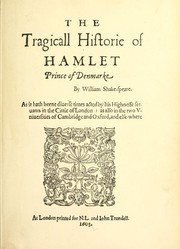
Hamlet by William Shakespeare is a classic tragedy exploring themes of mortality, revenge, and human consciousness. The enduring play was brought up across several cultural and literary podcasts, where hosts and guests debated its enduring relevance and artistic mechanics. Ross Douthat mentioned the play on Interesting Times to challenge the superiority of Shakespeare over popular fiction. On Modern Wisdom, Chris Williamson cited the iconic line about conscience making cowards of us all to examine the paradox of self-awareness and how overthinking can paralyze action. Reginald Dwayne Betts discussed a line from the play with incarcerated women on People I (Mostly) Admire, while Tyler Cowen referenced the work on How I Write while reflecting on Camille Paglia's provocative perspective that certain parts of the drama resist close logical analysis. On The Jordan B. Peterson Podcast, the host lamented the broader cultural shift away from classic literature in educational settings, pointing to Shakespeare alongside figures like Maya Angelou to emphasize the enduring value of canonical texts. Additionally, Freakonomics Radio host Stephen Dubner used the structure of Shakespearean tragedies like Macbeth and Hamlet as a literary analogy to describe the disorganized display of historical artifacts. Together, these varied references demonstrate how the play continues to serve as a vital touchstone for discussing philosophy, human psychology, and the very definition of literary greatness.
Who recommended it
- Tyler Cowen Discussed
- Victor Ehikhamenor Discussed
- Ross Douthat Discussed
- Chris Williamson Discussed
- Reginald Dwayne Betts Discussed
- Jordan B. Peterson Discussed
Tyler Cowen — 3 mentions
“Camille poglia once said if you look at Hamlet too closely most of it just doesn't make sense I'm not sure that's true”
“even for a fairly fixed historical topic take shakespeare's play hamlet this year there have already been at least 35 edits to that entry”
“so if I say well reading Hamlet Shakespeare Dostoevsky Jane Austen of course that was essential for one's own education”
Victor Ehikhamenor — 1 mention
“They are disjointed because it's like taking William Shakespeare's Magbet or Hamlet. You go to first act, you tear the page off, then you go to the last act and you tear it off. Then you paste it on the wall and call it William Shakespeare.”
Ross Douthat — 1 mention
“That lets us tell that we should be reading Hamlet before or distinct from reading the firm or a time to kill because Hamlet.”
Chris Williamson — 1 mention
“Thus conscience does make cowards of us all.”
Reginald Dwayne Betts — 1 mention
“and Hamlet and we were holding up Hamlet when he said blah blah”
Jordan B. Peterson — 1 mention
“but more particularly it arose in the humanities departments especially in in departments that were associated concentrating on literary criticism because the literary critics especially the french the post-modernist types came to a similar realization at some point um i'm condensing a lot of work here but their basic proposition was um well how do you know when you've landed”
Mentioned on the show without a named speaker — 6
“In general, the ditching of the classics where we said, 'Oh well, look at the list of books that students are to read—Maya Angelou, Shakespeare.'”
“He said they feel disjointed, like tearing the pages from William Shakespeare's Macbeth or Hamlet, wherein you might take the first act and then skip to the last act before pasting the pages on the wall and declaring it Shakespeare.”
“If you don't have that book yet, I want you to go in order right now and get Gut Feelings.”
“One of the things that I love is the name of the new book, Gut Feelings.”
“Everyone should check out the book, 'Gut Feelings' and tune in to 'The Art of Being Well' podcast for deeper insights.”
“I was reading this book about soldiers in World War II, and they were at the point where they knew they were in a situation where they were going to die. There were no ifs, ands, or buts—they knew they were gonna die.”
Also mentioned in the same episodes
- Macbeth
- A Brief History of Seven Killings
- A Gentleman in Moscow
- A Time to Kill
- Atlas Shrugged
- Awaken The Giant Within
Other mentions (3: passing, ad reads, own books)
“and Hamlet by Shakespeare, Fahrenheit 451 by Ray Bradberry, and Frankenstein by Mary Shelley.”
“One of the attorneys in the case actually used the analogy: a drunken monkey can eventually type Hamlet, there's this kind of old saw about how randomly typing you'll eventually type Hamlet, but why should we outsource our redistricting to a drunken monkey?”
“I mean, somebody started uploading the full text of Hamlet, for example, and we said, hmm, wait, hold on a second.”