
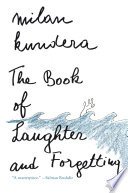
Book · 1994 · Continental european fiction (fictional works by one author)
Book of Laughter and Forgetting
A Novel
- mentions
- 4
- people
- 4
- podcasts
- 3
- episodes
- 4
- recommendation
- 1
Milan kundera has a book called The Book of laughter and forgetting which is a collection of short stories.
 Tim Ferriss · Modern Wisdom · May 2024 Listen at 1:37:40
The best things said about it
So um the Czech writer Milan Kundara was extremely important for me um the book of laughter and forgetting uh and the unbearable lightness of being and also his book the art of the novel immensely significant texts that seemed to have an incredible freedom.
 Alain de Botton How I Write · Jul 2025
Just like I read kundra's a book of laughter and forgetting and after I learned Czech it was part of my Czech language training at Berkeley.
 Stephen Kotkin Conversations with Tyler · Dec 2024
Graphomania, the desire to write books to a public of unknown readers. You talk about this. It's from Milan Kundera, from the book of Laughter and Forgetting.
Where and when it comes up
Most mentions, by podcast
4 people who brought it up
Why people recommend it
Book of Laughter and Forgetting by Milan Kundera is a philosophical novel structured as a kaleidoscope of interconnected stories and essays examining memory, political oppression, history, and human folly. Tim Ferriss recommended the book on Modern Wisdom as a powerful work of fiction that guides the reader through a rich spectrum of emotional states. Alain de Botton cited Milan Kundera's writings as an immense influence during an appearance on How I Write, highlighting The Book of Laughter and Forgetting alongside his other works for demonstrating extraordinary structural freedom and creative range. Stephen Kotkin mentioned reading the book as an integral part of his Czech language training at the University of California, Berkeley, noting its cultural and linguistic significance. Additionally, David Perell referenced the text on How I Write while discussing the sociological concept of graphomania—the compulsive desire to write books for an audience of unknown readers. Across these conversations, Kundera's work is celebrated for its stylistic brilliance, its profound meditations on totalitarianism and personal identity, and its enduring capacity to provoke deep intellectual and emotional reflection among readers and writers alike.
Every mention
Tim Ferriss Milan kundera has a book called The Book of laughter and forgetting which is a collection of short stories 1
“Milan kundera has a book called The Book of laughter and forgetting which is a collection of short stories”
Alain de Botton So um the Czech writer Milan Kundara was extremely important for me um the book of laughter and forgetting… 1
“So um the Czech writer Milan Kundara was extremely important for me um the book of laughter and forgetting uh and the unbearable lightness of being and also his book the art of the novel immensely significant texts that seemed to have an incredible freedom.”
David Perell Graphomania, the desire to write books to a public of unknown readers. You talk about this. It's from Milan… 1
“Graphomania, the desire to write books to a public of unknown readers. You talk about this. It's from Milan Kundera, from the book of Laughter and Forgetting.”
Stephen Kotkin just like I read kundra's a book of laughter and forgetting and after I learned Czech it was part of my Cze… 1
“just like I read kundra's a book of laughter and forgetting and after I learned Czech it was part of my Czech language training at Berkeley”