
Why people recommend it
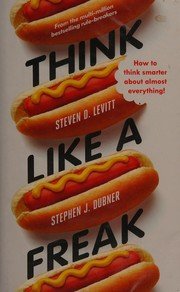
Think Like a Freak is a popular nonfiction book written by Steven D. Levitt and Stephen J. Dubner that applies unconventional economic thinking to everyday problem-solving and decision-making. The title, along with the authors' broader literary footprint—most notably their foundational book Freakonomics—was frequently discussed across various podcast episodes throughout 2023 and 2024 on shows like Freakonomics Radio, People I (Mostly) Admire, and No Stupid Questions. On Freakonomics Radio, host Stephen Dubner and various guests frequently referenced passages and arguments from the authors' catalog, exploring topics ranging from the historical link between legalized abortion and crime rates to the systemic prevalence of cheating in human endeavors. In a January 2023 episode, Dubner read directly from their 2005 work to introduce a discussion on dishonesty. Similarly, on an episode of People I (Mostly) Admire, co-author Steve Levitt discussed Think Like a Freak, highlighting how the book examines business environments and addresses the universal reluctance of professionals to utter the phrase I don't know. Across these programs, the authors' books served as an analytical framework for challenging conventional wisdom, examining human behavior through data-driven incentives, and encouraging listeners to question underlying assumptions in business, policy, and daily life.
Who recommended it
- Steve Levitt Discussed
- Stephen Dubner Discussed
Steve Levitt — 1 mention
“It's interesting because in the book that Stephen Dubner and I wrote called Think Like a Freak, we talk about the business context. One of the things we say is nobody ever in a business context says, 'I don't know.'”
Stephen Dubner — 1 mention
“You know, it reminds me a little bit of the argument that we made in the first Freakonomics book about names. So there's a lot of literature, including some done by Steve Levitt and Roland Fryer, about how influential a person's first name is on their life.”
Mentioned on the show without a named speaker — 11
“If you've ever read Freakonomics, the namesake book of this show, you may recall this controversial link between legalized abortion and the fall of crime.”
“He's made that brand his life after co-writing Freakonomics back in 2005, which I read back in 2005, and it blew me away. I couldn't believe the kinds of questions that he was asking that made sense.”
“Oh my god, well, you know, I'd be happy to be the face of the Freakonomics podcast and the Freakonomics book empire. So keep me on speed dial!”
“I've been a big fan for a long time; I actually dusted off my old copy of Freakonomics last night.”
“I rarely do this, but today I'm going to start by reading a couple of sentences from Freakonomics, which Steve Levitt and I published in 2005: 'Cheating, we wrote, may or may not be human nature, but it's certainly a prominent feature in just about every human endeavor. Cheating is a primordial economic act, getting more for less.'”
“But a lot of Republicans have come to believe the death penalty does not deter crime, which happens to be an argument we offered evidence for in Freakonomics.”
“I knew that this would be very electric to some individuals, abortion and crime revisited, an update of our 2019 episode and of the theory we wrote about in our first Freakonomics book way back in 2005. That's next week on the show.”
“In the first Freakonomics book, published in 2005, Steve Levitt and I wrote about one such consequence of the original Roe v.”
“If you've ever read Freakonomics, the namesake book of this show, you may recall this controversial link between legalized abortion and the fall of crime.”
“In the first Freakonomics book that Steve Levitt and I wrote, there was one chapter called "What Makes a Perfect Parent."”
“A few years after that first Freakonomics book, when I started this podcast, we did an episode called The Economist's Guide to Parenting.”
Also mentioned in the same episodes
- An A to Z of food and drink
- An A-Z of food and drink
- Can I Ask You a Question?
- Grit
- How to Say Goodbye
- The Case against Education
Other mentions (7: passing, ad reads, own books)
“I was going to say I always say sometimes, I don't want to make a declarative that all things, but my immediate reaction went back to the book Freakonomics.”
“I think they were at a swimming pool and everybody's jumping around having fun, and she's sitting by the pool reading Freakonomics!”
“She writes, 'He inspired me to read all the Freakonomics books, and he was the reason I wanted to major in economics.'”
“She says, 'I have gotten him Freakonomics books for the last three years. Poor fellow, and vice versa.'”
“It reminds me of something that Steve Levitt and I wrote about in one of our Freakonomics books, Think Like a Freak, and it was about this charitable organization called Smile Train. Are you familiar with Smile Train?”
“you did write a self-help book Think Like a Freak yeah the third Freakonomics book we wrote was our attempt at a self-help book called Think Like a Freak”
“what if we could write a kind of guidebook to how we do our thinking and our data collection and our analysis and our storytelling and so yeah if we did sort of write a self-help book”