
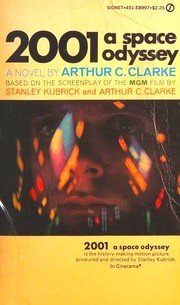
Book · 1968
2001, a Space Odyssey
A Novel, Based on the Screenplay by Stanley Kubrick and Arthur C. Clarke
Why people recommend it
2001, a Space Odyssey by Arthur C. Clarke and Stanley Kubrick is a seminal science fiction masterpiece that investigates human evolution, artificial intelligence, and extraterrestrial life. Lex Fridman concluded an episode of his podcast by quoting Arthur C. Clarke to reflect on humanity's role in the cosmos. On Modern Wisdom, Lionel Page used the monolith and the sudden awakening of early hominids as an evolutionary analogy for the emergence of human reason, a theme also echoed by Matthew Walker when discussing novel biological and cognitive leaps. Chamath Palihapitiya brought up the book on All-In to explore how early technological concepts influenced modern premises regarding UFOs and alien existence. On Stuff They Don't Want You To Know, Ben highlighted the narrative's strong focus on the moon Europa. Elon Musk referenced the story on the Lex Fridman Podcast to illustrate the inherent dangers of programming artificial intelligence to deceive humans. Furthermore, Ariel Ekblaw and Bret Weinstein invoked the artificial intelligence HAL and the notion of intelligent space habitats during separate appearances on Lex Fridman's show, using the classic story to debate the future of robotics, space colonization, and autonomous technology.
Who recommended it
- Lex Fridman Recommended
- Lionel Page Discussed
- Chamath Palihapitiya Discussed
- Matthew Walker Discussed
- Elon Musk Discussed
- Ariel Ekblaw Discussed
- Bret Weinstein Discussed
- Neil deGrasse Tyson Discussed
Lex Fridman — 3 mentions
“and now let me leave you some words from arthur c clarke who is the author of 2001 a space odyssey it may be that our role on this planet is not to worship god but to create him”
“but what do you make of the monolith in 2001 Space Odyssey in terms of aliens communicating with us and sparking the the kind of particular intelligent computation that we humans have”
“taking that analogy further and distorting it let's enter a sign science fiction world to say Space Odyssey 2001 with hell yeah or or maybe which is probably one of my favourite AI movies”
Lionel Page — 1 mention
“um a a good a good a good a good image that you can have for reason how what it is is you know the the movie the Stanley Kubri movie um 2001 the space odyssey and you have this bunch of apes and they're pretty useless and then suddenly they wake up one morning and there's this uh monolith”
Chamath Palihapitiya — 1 mention
“I think the whole premise of like UFOs moving bodies around is rooted in the current state of Technology of humanity which is the basis of Arthur Clark's treatment of 2001 A Space Odyssey not which was done before the screenplay which was done before the book”
Matthew Walker — 1 mention
“that's the novel difference between 2001 and Space Odyssey where they're banging bones around and then all of a sudden one of them realizes Christ this thing is actually a weapon”
Elon Musk — 1 mention
“So in "2001: Space Odyssey," what Odyssey clock was trying to say,”
Ariel Ekblaw — 1 mention
“maybe not all the way to hal and the you know 2001 space odyssey reference that scares people about the habitat having a mind of its own”
Bret Weinstein — 1 mention
“so I'll be very interested to see what happens in your robot project if you do not end up Reinventing childhood for robots which of course foreshadowed in 2001 quite brilliantly”
Neil deGrasse Tyson — 1 mention
“so start with 2001 a space odyssey all right that had aliens in them you just never saw them”
Mentioned on the show without a named speaker — 2
“And I'll just leave it with this: in the Arthur C. Clarke novel '2001: A Space Odyssey,' of course the film is based on that too, Europa comes up a lot.”
“If you read the original treatment written by Arthur Clarke for the movie 2001: A Space Odyssey, which was written before the movie and then the book was written after the movie, he makes a really compelling point. He says that when civilizations achieve a sophisticated enough level of technology, there's no longer a need to physically transport yourself from”
Also mentioned in the same episodes
- 2001
- A new kind of science
- Contact
- Deep Work
- Diagnostic and Statistical Manual of Mental Disorders
- Ender's Game
Other mentions (5: passing, ad reads, own books)
“I'm mentioning Honda Space Odyssey for sure.”
“That's the famous live from 2001, a space Honda Odyssey.”
“My fiance is reading 2001: A Space Odyssey right now and its sequels, and he was a big fan of Liu Cixin's The Three-Body Problem trilogy, and he's telling me he can see where the Clarke influence comes from.”
“As earliest evidence in, what was it, 2001: A Space Odyssey, right? Okay, "Would it be realistic to use this idea for long term space travel?"”
“and it would be like from our point of view be like 2001 or there's an you know an monolith monolith”